Ali Hassan Bhuiyan :
Surely, Allah is the only deity worthy of worship, the Most Pure, Holy, and Free from all imperfections, and indeed I am among the wrongdoers. Blessings and peace be upon the Guide to the Straight Path, the Beloved of Allah, the Messenger of Allah Hazrat Mohammad (peace and blessings be upon him). I pray for Allah’s mercy and forgiveness upon Hujjat al-Islam Imam al-Ghazali (may Allah have mercy on him), who raised the subject under discussion.
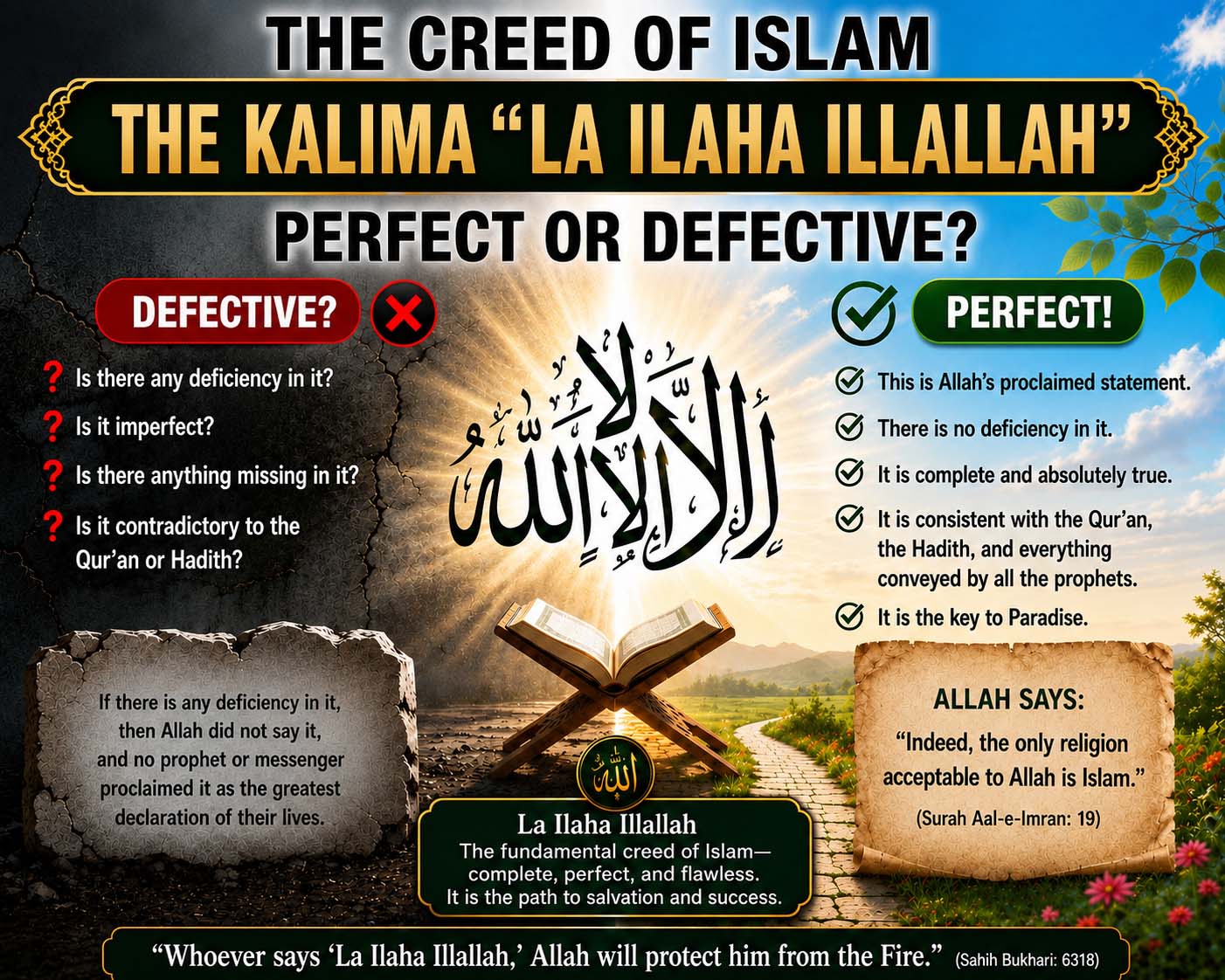
Our topic is the fundamental creed of Islam, or rather the foundation upon which the Muslim world stands, namely the first part of the Kalimah Tayyibah , the flag of Islam, La Ilaha Illallah (“There is no deity worthy of worship except Allah”). The question is whether this statement is complete or defective. This question was asked by a scholar to Imam al-Ghazali (may Allah have mercy on him). The seeker was confused about why the spiritual elite (Arifin) move from La Ilaha Illallah to La Huwa Illa Huwa, and whether this undermines the primary Kalimah. His second query was how created things can be said to exist if Allah is the only True Reality.
This historical doubt raised by the scholar to Imam al-Ghazali is not merely a matter of the past; its reflection is clearly evident in modern academic research as well. For instance, scholar Alexander Treiger, in his work ‘Monism and Monotheism in al-Ghazālī’s Mishkāt al-anwār’, contends that there exists an inherent theological tension or conflict in al-Ghazali’s philosophy between ordinary monotheism (La Ilaha Illallah) and the experience of higher existential monism (La Huwa Illa Huwa). Similarly, Patrick Laude, in his book ‘Non-dual Reality and Ghazālī’s Metaphysics of Unity’, compares this transition to Eastern Non-dualism, suggesting that before the Absolute Reality, the actual existence of creation becomes virtually nominal or illusory.
To arrive at a correct resolution to both the doubts of that historical scholar and the premises of these modern researchers, it is necessary to re-examine, through a new lens, the interrelationship between knowledge, logic, thought, and faith, alongside the relative existence of creation, the absolute reality of the Creator, and the mathematical principles underlying both.
Imam al-Ghazali (may Allah have mercy on him), in his famous spiritual and Sufi philosophical work “Mishkat al-Anwar” (مشكاة الأنوار – The Niche of Lights), discussed and explained this subject in a very refined manner.
Through these expressions, he explained two profound levels or stages of Tawhid (the doctrine of Divine Oneness):
- Two Levels of Tawhid (General vs. Special)
La Ilaha Illallah (لَا إِلٰهَ إِلَّا الله): According to Imam al-Ghazali, this is Tawhid al-‘Awwam, the monotheism of the common people. Its outward meaning is: “There is no true deity worthy of worship except Allah.”
La Huwa Illa Huwa (لَا هُوَ إِلَّا هُوَ): He referred to this as Tawhid al-Khawas, the monotheism of the spiritual elite. Its deeper meaning is: “There is no true existence except Him.”
- The Example of the Sun’s Light
In Mishkat al-Anwar, Imam al-Ghazali (may Allah have mercy on him) provides a beautiful example.
He says that when we see light on the earth during the daytime, it appears as though the light belongs to the walls, the ground, or the surrounding objects. However, in reality, that light has no independent existence; it depends entirely upon the light of the sun. If the sun did not exist, that light itself would not exist.
Likewise, the existence of all creation in the universe—human beings, the heavens, the earth, and everything else—continues only because of the existence granted by Allah. If Allah were to withhold the manifestation of His Light (Nur) or His Power, then the entire creation would become void or non-existent in a single moment.
- The Stage of Fana (Self-Annihilation)
Imam al-Ghazali explained that when Sufi seekers (Arifin) reach the highest stage of spiritual discipline, all thoughts and attachments other than Allah are removed from their hearts. At that point, they dissolve even their own sense of existence into the Will of Allah (which, in Sufi terminology, is called Fana fi Allah). In this state, nothing remains in their hearts except Allah, and it is then that they realize the ultimate truth and proclaim with all their heart and soul: “La Huwa Illa Huwa” (“There is no independent existence except Him”).
Imam al-Ghazali’s profound doctrine essentially points to the absolute sovereignty of Allah and His exclusive dominion over the universe.
According to the statement of Imam al-Ghazali (may Allah have mercy on him), La Ilaha Illallah is the belief of the common people, and after attaining the perfection of Tawhid, that belief transforms into La Huwa Illa Huwa. La Ilaha Illallah, or “There is no deity worthy of worship except Allah,” is the declaration of monotheism for the common people, whereas La Huwa Illa Huwa, or “There is no he except He,” is the declaration of monotheism for the spiritually distinguished. “There is no deity worthy of worship except Allah” expresses the general meaning, while La Huwa Illa Huwa, or “There is no he except He,” expresses the special meaning. The second expression is extremely subtle and carries a much broader significance.
Regarding this, he stated:
- La Ilaha Illallah is the Speech of Allah, than which no other statement can be superior. However, saying that another statement is superior applies only in the case of the Prophets, Messengers, and the friends of Allah (Awliya Allah), and not in the case of ordinary people.
- Allah has certainly distinguished between La Ilaha Illallah and La Huwa Illa Huwa. The instruction given to ordinary people is not exactly the same as that given to the Prophets and Messengers; there are certain differences.
- La Huwa Illa Huwa is in accordance with the Shariah.
At this point, the question arises: How can such a classification be considered correct in matters of faith (Iman) or Tawhid? At the same time, it appears to diminish the Kalimah, which is the very foundation of the religion, and to portray it as incomplete. On the other hand, La Huwa Illa Huwa, meaning “There is no he except He,” appears to be an incomplete expression. How, then, can the perfection of Tawhid be achieved through it?
In response to this question, Imam al-Ghazali (may Allah have mercy on him) stated in his work Maktubat that the phrase La Huwa Illa Huwa was not intended to represent an independent Kalimah. Rather, it merely expresses the inner meaning and complete essence of the Kalimah La Ilaha Illallah. Through this expression, he intended to convey a concept of broad significance whose explanation is extremely profound and whose meaning is exceedingly comprehensive.
Now, several further questions naturally arise. How does the phrase La Huwa Illa Huwa fully express the essence of the Kalimah La Ilaha Illallah? From where did the phrase La Huwa Illa Huwa originate? The literal breakdown of the phrase is: La (لَا): ” No, There is no or There is none,” Huwa (هُوَ): “He,” Illa (إِلَّا): “except,” Huwa (هُوَ): “He.” Thus, the literal rendering is “There is no or There is none He except He,” which, when translated word for word into English, appears to convey no coherent meaning. To what extent is it reasonable to say La Huwa Illa Huwa instead of La Ilaha Illallah, and why has it been described as superior, even though it is impermissible and illogical to regard anything as superior to the Speech of Allah? Before discussing this subject, it is necessary for us to understand a few matters: What is knowledge? What is Iman (faith)? What is meant by logic? What is the nature of thought? And what is the true meaning of Tawhid?
Knowledge
Knowledge is the weapon with which one fights against Satan. In other words, knowledge is the name of reality established through logical evidence and proof. Fundamentally, knowledge is to know and comprehend the determined limits and boundaries of all created things (both visible and invisible) created by the Creator.
Iman (Faith)
The technical meaning of Iman is belief. Following the opinions of one’s forefathers and maintaining a positive attitude toward the one who possesses its profound mysteries is called Iman. From an ordinary perspective, this is the definition of faith. Every religion and every nation possesses faith or belief. But are all beliefs logical and free from doubt? No. Even within the Muslim community, whose religion is fundamentally based on faith, there are differences of opinion on many matters. Wherever there remains room for criticism, which is not true faith. Rather, faith is that human conviction which is free from doubt and hesitation, supported by reason, and beyond dispute.
Logic
Logic is the undeniable and well-established system of principles and laws imposed by the Creator upon nature. In other words, logic is the unchangeable and irrefutable system of rules that is independent of time, age, and place.
Thought
Thought is the process of considering, in the light of reality, what may happen and what may not happen. In other words, with respect to a particular event, before making a decision or taking action, a person internally performs rational reasoning and intellectual calculations regarding one or more possible determined or undetermined outcomes. This process is called thought.
It should be noted that there is a difference between thought, worry, and imagination. Thought may concern worldly matters, spiritual matters, or both, but it is based on reality and is free from harmful consequences. Worry, however, concerns only worldly affairs and carries negative consequences. Imagination, on the other hand, consists of thoughts that are detached from reality.
Tawhid
In Islam, the concept of the One Allah is referred to as Tawhid. The opposite of Tawhid is Shirk, which means associating partners with Allah or affirming plurality instead of absolute oneness.
The literal meaning of the word Tawhid is monotheism. In practical terms, Tawhid means affirming the Oneness of Allah. In the terminology of the Shariah, Tawhid means acknowledging Allah the Exalted as One and Unique.
The fundamental principle of Tawhid is that Allah the Exalted is One and without partner. He alone is worthy of all praise and worship. There is none comparable to Him. Allah the Exalted has said: “There is nothing like unto Him.”(42-11)
All the teachings and principles of Islam are founded upon Tawhid. Every Prophet and Messenger who came into this world called people toward Tawhid. The essence of all their call was: “La Ilaha Illallah”—there is no deity except Allah.
In order to become a believer (Mu’min) or a person of faith, one must first believe in the Oneness of Allah and have faith in it. Without belief in Tawhid, no person can enter Islam or become a believer.
It is established through various Hadiths and verses of the Qur’an that faith (Iman) in Tawhid is not the same for everyone. The hypocrites (Munafiqun) also claim to possess faith, but are they truly believers? On the other hand, the Qur’an uses terms such as Mu’min (believer), Imandar (faithful), and Muttaqi (God-conscious) to indicate that the level of faith among the Muslim Ummah may differ from one individual to another, and this is consistent with reality. This is because the level of knowledge is not the same for every person; it differs from one individual to another.
Furthermore, the nature, degree, and development of a person’s faith depend upon the depth of his thinking. The depth of thought depends upon logic, and logic, in turn, depends upon knowledge. An example of this is Abu Bakr (may Allah be pleased with him). Although the Messenger of Allah (peace and blessings be upon him) had more than one hundred thousand Companions, the title As-Siddiq was bestowed upon him. He was granted the title As-Siddiq by Rasulullah (peace and blessings be upon him) due to his unwavering conviction regarding the event of Isra and Mi’raj. This instant belief stemmed from his deep knowledge of Allah and His Messenger (peace and blessings be upon him). Likewise, Umar (may Allah be pleased with him), Uthman (may Allah be pleased with him), Ali (may Allah be pleased with him), Abu al-Darda (may Allah be pleased with him), and other Companions—especially the veterans of the Battle of Badr—were praised by the Messenger of Allah (peace and blessings be upon him) for their faith and were granted a higher rank than the other Companions.
From the above discussion, it appears that the perfection of a person’s faith and his closeness to Allah depend upon knowledge. If one reflects deeply, it becomes evident that the phrase La Huwa Illa Huwa is complementary to the phrase La Ilaha Illallah. In essence, both expressions convey the same meaning.
In the Qur’an, the Lord of the Worlds has said: “Your deity is One God,” (2:163) “There is no deity except your God,” (5:73) and “There is no deity except Allah.” (37:35) Many other verses of a similar nature have also been revealed. If these verses are analyzed deeply, it becomes evident that the word Ilah which means God refers to Allah alone. A person with perfect faith cannot even imagine the existence of any deity other than Allah, because the word Ilah is one of the descriptive attributes (Sifat) of Allah the Exalted, whereas the name Allah is His essential and proper Name (Dhat). In other words, just as saying Allah refers to Ilah, saying Ilah also refers to Allah.
For example, Bismillahir-Rahmanir-Rahim means, “In the name of Allah, the Most Compassionate, the Most Merciful.” Here, Ar-Rahman and Ar-Rahim are descriptive names that express the attributes of Allah, whereas the name Allah expresses the essential identity of the Lord of the Worlds. Whether one calls upon Allah by saying Allah, Ar-Rahman, or Ar-Rahim, in every case the same Being is intended. According to the Qur’an: “Call upon Allah or call upon Ar-Rahman; whichever name you call, to Him belong the Most Beautiful Names.” (17:110)
According to the above discussion, if, in the Kalimah La Ilaha Illallah, the word Ilah is replaced by the word Allah, the expression becomes La Allah Illallah, whose literal meaning is: “There is no Allah except Allah.” Now, according to the rules of grammar, if the proper noun Allah is replaced by the pronoun He, the expression becomes: “There is no he except he,” or La Huwa Illa Huwa.
Therefore, La Huwa Illa Huwa is not a separate Kalimah; rather, it is another form of La Ilaha Illallah. Although, at first glance, the phrase may appear to convey an incomplete or disconnected meaning, in reality it carries a comprehensive meaning, as will become clear from the following discussion.
Another point to be discussed is that just as La Ilaha Illallah means “There is no deity except Allah,” the Qur’anic expression Allahu La Ilaha Illa (Ayat al-Kursi) conveys exactly the same meaning: “Allah,there is no deity except .” Yet, instead of adopting Allahu La Ilaha Illa as the Kalimah, the form La Ilaha Illallah was adopted, whose literal meaning is: “There is no deity worthy of worship except Allah.”
One possible primary reason for this is grammar, although there may be several other reasons as well. These include:
- Easy To Understand.
- Expressions in one statement.
- Introduction of Logic.
- Origin.
- Expression of reality.
- The Algebraic Logic in La Ilaha Illallah.
Before providing the above-mentioned explanation, it is necessary to know two matters. And they are what the purpose of creation is and what the relationship between the Creator and the servant is. The purpose of creation will be discussed in the chapter of Origin. Here, the relationship between the Creator and the servant is discussed.
The verses mentioned in the Qur’an and the Hadith make the matter of the said relationship known. Among the verses described in the Qur’an are a few verses: 1- “I have created the jinn and mankind only that they may worship Me. (51:56)” 2- “On that Day, no one will be wronged, and even if anyone has done an atom’s weight of good deeds, it will be presented before him. (36:54)” 3- “What kind of record of deeds is this in which no small or great sin has been left out?” (18:49) 4- “Everyone will be given the full recompense of his deeds. (39:70)” 5- “Today you alone are sufficient to take your own account. (17:14)” On the other hand, in the Hadith it is stated that the Messenger of Allah (peace be upon him) said, the duty of the servant towards the Lord of the Worlds is that the servant will worship Him alone without associating anything with Him. And the duty of the Lord of the Worlds towards the servant is that if the servant worships Him without associating anything with Him, He will not punish the servant.(Bukhari -7373)
By reviewing the above-mentioned verses and Hadith, it is seen that the relationship between the servant and the Lord of the Worlds is worship and His reward for it; but it is conditional. Although worship and its reward are related to the subject under discussion, if they are discussed in detail, the statement will only become lengthy. Therefore, it is sufficient to know only this much: whatever thought or action is done by accepting the Lordship of Allah will be regarded as worship, and its reward will be given. On the other hand, no matter how many good deeds are done without accepting Him or by committing shirk, they will be considered fruitless, and their recompense will also be given.
Anyway, by discussing the above-mentioned matters sequentially, it is hoped that the meaning of the said two statements will be made clear easily.
- Easy to understand: La Ilaha Illallah, or There is no deity except Allah. Directly, for the understanding, remembering, and at the same time fluent expression of all nations, all religions, all classes of people, the intelligent, the foolish, the educated, the uneducated, everyone, that is, the general public; and indirectly, for distinguishing between Muslims and non-Muslims, La Ilaha Illallah has been accepted as the Kalimah.
- Expressions in one statement: Just as, in the case of Surah Al-Fatihah, it is said that the Surah is the summary of the entire Holy Qur’an, likewise the statement La Ilaha Illallah is the expression in one statement of the Holy Qur’an together with all the heavenly Books. Although naturally La Ilaha Illallah, or La Huwa Illa Huwa., appears as a single sentence, in reality each of its words is representative of a separate sentence, and at the same time those words express different meanings in different places according to their usage. No and He, the two words, each represent a simple sentence, and except He represents a compound sentence. At the same time, this Kalimah describes law of the creation and the Creator, the nature of the creation, and the nature of the Creator, which are analyzed according to the following order. It should be noted that, for the convenience of discussion, pronouns have been used here in the same way as they are used in grammar, and except for this one case, La Ilaha Illallah is the best in all cases, and possibly Imam Ghazzali (R.) paid attention to this matter.
Another matter is that since Rabbul Alamin exists in His full form, an intransitive verb “exists”, whether a noun or a pronoun is used, must grammatically be assumed to be connected with Him. That is, the main expressed state of the sentence is as follows: “No or There is none, He (exists), Except He (exists)”. At the same time, another point is that the inner meaning of the Quran and Hadith has been adopted in this discussion, not the literal one.
Law of Creation: If thought about deeply, two types of laws will be observed in the case of the created human or Jinn race. Either they will be monotheists, or they will be disbelievers or polytheists. It cannot be anything outside of this. The said law is expressed by “There is none” and “He (exists)” in the following way.
No or There is none: The word “La” means no or there is none. The word “La” or “there is none” refers to one division of creation, meaning the disbelievers, polytheists, and a class of hypocrites who hold Muslim names but do not have Allah in their worship or belief (this is the one case where Allah may not be present), and even if He is, it is mixed with polytheism. There is no value to their worship, deeds, or actions. This matter has been discussed in detail in the Quran.
He (exists): The word “Ilah” means deity. Although the word is an adjective, it expresses the other division of creation, meaning the monotheists, their deeds or actions, and their evaluation. By monotheist, it does not only intend the followers of Islam, but rather it also means those who belong to other religions but accept only one and single entity as their Lord, worship Him alone, and associate nothing with Him.
Here is a point that needs to be discussed. If observed deeply, it will be seen that there is no real existence of anything as “la” or “no” (no/nothingness). It is merely a concept because even something that has nothing still has one thing, and that is its name. In Quran “And He taught Adam the names — all of them. Then He presented them to the angels and said, ‘Inform Me of the names of these, if you are truthful”(2:31). Analyzing it even more subtly, it will be seen that the word “la” or “no” is a relative matter, which varies or differs depending on time, place, and person. (As a real-life example, Rahim does not have wealth, but Karim has a lot of wealth). To express the entity that “He exists” or “the Creator exists,” “no” (nothingness) or rather various words have been introduced.
There are many things in the created world that exist only in name, with no real existence, meaning they are nominal. For an example Ghost. “We can conceive of ghosts, but they do not exist in reality. “Another example can be given from Quran, “Have you considered al-Lāt and al-‘Uzzā, and Manāt, the third, the other”?(53:19–20). Though these Deities were worshiped but in reality they don’t have any real existence. According to Quran “They are not but [mere] names you have named—you and your forefathers—for which Allah has sent down no authority. They follow not except assumption and what [their] souls desire, and there has already come to them from their Lord guidance.”(53:23).
On the other hand Heaven and Hell. We can’t see it but it doesn’t mean it has no existence. Those who are monotheists will be able to fully comprehend this matter because they certainly believe in the unseen (Ghaib). Because monotheists believe this—leaving this worldly life is not the end, there is life after it. To shed light on these aspects, many verses have been introduced in the Quran. Among them are notably: 1- “And hasten to forgiveness from your Lord and a Garden as wide as the heavens and earth, prepared for the righteous.(3:133–134), 2- “And fear the Fire, which has been prepared for the disbelievers.”(3:131).
Anyway, a real-life example of how the word “no” (nothingness) is merely a concept is atmospheric low pressure. In the case of low pressure, if it appears that there is no air in that place over time (though its duration is very temporary), it does not mean that the place is empty or there is nothing. Because even if there is no air, the presence of waves is not unusual, and quite the opposite, meaning even if there is air, there may not be waves. It is worth noting here that “no waves” refers to the capacity of the detecting instrument. To put it more simply, particle theory can be mentioned. According to particle theory, the presence of photons is significant. Because along with the word “no” (nothing), its synonyms such as empty, void, vacant, etc., have been introduced to express one core message, and that is: He exists.
Another example is the east and the west. In reality, there is no such direction as east and west. It is merely a concept that depends on the sun. Since the earth is round like an orange and the sun also revolves relative to the earth’s own axis, the point on the earth where the sun rises is exactly opposite to where it sets, and where it sets is exactly opposite to where it rises. East and west are determined based on the rising and setting of the sun. The direction that is west in Bangladesh is east from the perspective of America. In reality, there is no fixed basis for determining east and west as there is for determining north and south based on the two poles. For this reason, the Qur’an states, “Lord of the two easts and the two wests,”(55-17) which means that what is referred to as two is in fact not an actual existence but rather a concept. The same distinction can be understood through numerical concepts. For example, a human being has five fingers on one hand. Each finger is an individual entity and may be distinguished by its own name or designation. However, “five” is not itself a separate physical entity in addition to those five fingers. It is a numerical concept formed by counting them individually: 1 + 1 + 1 + 1 + 1 = 5. Likewise, when we say that the world has eight billion people, “eight billion” does not refer to a separate entity called “eight billion”; rather, it is a numerical designation resulting from counting individual human beings. Thus, a number can represent a plurality of individual existences without itself constituting an additional independent existence.
The Law of the Creator: “Although Rabbul Alamin (Lord of the Worlds) can do whatever He wills and He is not accountable to anyone for that, rather it is better to say there is no one to question Him. Even then He has established an ordinance for Himself which He does not act against. Whoever it may be, whether a monotheist, an atheist, or a polytheist, the result will be given in every case. Punishment may be given, or forgiveness may also be granted. In no case is there anyone to question Him. Because He alone possesses insight and He alone possesses complete knowledge of all matters. By “Except Him,” this ordinance has been expressed.
Except He (exists): The word “except” is a conjunction that connects two clauses and expresses only one of two kinds of meanings. For example: 1- Karim has no brother except Rahim. 2-Karim has (one, more than one, many) brother besides Rahim. It should be noted that every sentence has an objective and an intended meaning. By “except Him (exists),” neither the objective nor the intended meaning of the sentence is naturally fulfilled.
Since it has been established in the previous discussion that Allah Ta’ala alone is the One who grants recompense, if the sentence is written as follows: “Those who are worshiped have no power whatsoever to grant any recompense, except he allow it.,” then both the objective and the intended meaning of the sentence are fulfilled, and at the same time it conveys a special meaning.
The Nature of Creation: In every aspect of creation, Rabbul Alamin has manifested His Oneness. La Ilaha Illallah, or the manifestation of His Oneness, is not only verbal, but through action as well. That is, the application of these words also exists within creation and the nature of creation. This is discussed below.
No or There is none: Now, if one observes a little more deeply, one thing becomes evident throughout the whole of creation, and that is dependence. To put it more simply, no created being is self-sufficient; every created being is incomplete in one way or another. That is, perfection does not exist. For example, a human being cannot survive without eating. This is what is meant by “La” or “No or there is none.”
He (exists): Naturally the question arises how can the Lord of the Worlds remain within the nature of creation? Basically due to not understanding the core statement of this matter, some communities facing this confusion have equated the creation with the Creator or rather have done so well. If observed, one thing will definitely be noticeable in the case of every creation and that is individuality. Put simply, whether external or internal, structure, characteristics, qualities or character etc., difference will be observed in some way or another even if in any one aspect. For example human fingerprint (fingerprint) which is not the same for any human. For this reason it is said that He is present amidst the entire creation. According to the hadith: “I have created Adam in My likeness”.Bukhari (6227)
Except He (exists): Naturally the question arises how the expression of the phrase except he (exists) can take place? First it is necessary to know how else the Lord of the Worlds can remain with the servant. Since the nature of the servant is being discussed here, it is also important to know what other forms the nature of the servant has. Making haste or transgressing limits is a nature of the servant. On the other hand, making haste or transgressing limits is an act disliked by the Lord of the Worlds. Therefore, in the case of the nature of creation, the actual essence will be expressed if the sentence is as follows: He is with all servants except those servants who make haste or transgress limits. Stated otherwise, as long as the servant remains within the limits prescribed by the Lord of the Worlds, He is with the servant, outside of this He is not.
Nature of the Creator: Like creation, the Creator also has a nature, better to say attributes, the expression of which has also been made through the said Kalimah.
No or there is none: In the case of the Lord of the Worlds, only one matter is expressed by (La) No or There is no, and that is flaw. Meaning He is free from all flaws. Therefore it is said Subhanallah. He is Holy.
He (exists): Although He is not visible, yet the Lord of the Worlds exists residing in His own essence. Now naturally the question arises then how is He? He is expressed through creation and its management, which is the manifestation of His attributes and through this He is expressed, which is perceptible. It is further mentioned that He is the sole owner of all attributes, which is a matter of realization. For the said reason it is said, Alhamdulillah meaning He is the owner of all praises.
Except He (exists): If we notice in the creation then we will see that there is only one giver and that is Rabbul Alamin and everyone is receiver. As previously mentioned, the sentence is as follows— other than Him (exist) there is no other giver. In another way it can be said, other than Him (exist) all others are receivers. Therefore it is said Allahu Akbar or Allah is Great.
- Introduction of logic: The Kalimah La Ilaha Illallah introduces a piece of logic, or rather better to say a formula. Previously it has been mentioned what logic means, so keeping the discussion brief rather than long, it is stated concisely.
No or There is none: The word “no” is entirely relative. Just like that, among numbers, the number 0 is also relative. On the surface, although the activities of those opposed to Tawhid seem valuable, essentially they can be worthless, because they are limited to this world. Therefore, if the logical and realistic form of the sentence expressed by “there is no” or “no” were expressed in numbers, it would be comparable to 0. Because 0 has no inherent value of its own, other numbers are dependent on it. Placed to the left of any number it has no value; on the other hand, placed to the right of a number, its value is expressed, but that depends on the value of the other number.
He (exists): Since the sentence expressed by this word represents monotheists or followers of Tawhid—or rather, a designated group—it represents 1 when expressed in numbers.
Except He (exists): Since through these two words a compound sentence—that is, two sentences—is manifest, of which one signifies that there is only one rewarder who possesses all qualities, and the other signifies that no one else has the power to reward or is devoid of qualities; therefore, when these two sentences are expressed in numbers, they can be expressed in the following manner: 1, 0. In other words, the numerical expression of La Ilaha Illallah can be represented like this: 0, 1, 1, 0. Whoever has even a little bit of an idea regarding the present-day world, computers’ binary numbers, and the positive and negative charges of electricity, will be able to comprehend the essence of this statement.
- Origin: According to the Quran, “There is no one to question Me, I alone will question everyone”(21-23). The truth of this statement is beyond description, because there is no scope for questioning. Because what is a question today, tomorrow it is considered as an answer. It is mentioned in a Hadith Qudsi that the Lord of the Worlds said, “I was hidden, I wished to make Myself known, so I created.” If we examine the mentioned Hadith, we will see that the reason for creation is the will of the Lord of the Worlds. Although will is an action, it is related solely to His own essence. In other words, it can be said that will is an internal matter which is entirely a relative matter. It has no value without practical manifestation. Numerically, it is comparable to 0. On the other hand, action, meaning creation, is the manifested form. Expressing it numerically, 1 (the entire creation) is its manifested form.
Now, grammatically, the definition of action is: the will of the doer is the action. Then the converse is also true, meaning the action of the doer is the will of the doer. Because in both cases the objective is the same and that is recognition. Therefore, the said Hadith can be stated this way: “I was hidden; I created because I wished to make Myself known.”
Just as the numerical expression 0, 1 is correct, similarly 1, 0 is also correct.
- Expression of reality: This kalam (word) expresses all three realities of creation—past, present, and future.
No or There is none: According to the Quran, “A time has passed over creation when it was nothing worthy of mention.”(76-1) This means creation had a starting point, and even before that, time existed, which modern scientists refer to the Pre-Big Bang era.
He (exists): This expresses the present time and gives the concept of the ongoing existence of human life. Modern scientists call this the post-Big Bang era.
Except He (exists): This expresses the future. That is, beyond this worldly life, there is another life, which indicates the hereafter. Modern science has no direct concept about this; however, in light of various discoveries of modern science, an idea about its possibility can be formed.
- The Algebraic Logic in La Ilaha Illallah: The foundational declaration of Islamic faith La Ilaha Illallah establishes a fundamental distinction between the Creator and creation. It is established that Allah alone is worthy of worship and that there is no Ilah other than Him. This raises an important theological question regarding the relationship between the word Allah, which is the Proper Name (Ism al-Dhāt) of the Creator, and Ilah, which denotes a category of worship. While Ilah describes a quality or position that can conceptually be applied within creation, Allah cannot be understood as possessing qualities that are acquired, added, or separated from His Essence (Dhāt). The Divine Names and Attributes are not external components that combine to form Allah; rather, they express the same indivisible and absolute Divine Reality.
This distinction can be understood by comparing the structural nature of creation with the nature of the Creator. Created beings possess qualities that are variable, acquired, and distinguishable from one another. For example, suppose an individual, Kevin Barrett (X) possesses three distinct qualities: kindness (a), graciousness (b), and mercy (c). For conceptual representation, his composite state can be expressed as:
X = a + b + c
Here, the individual is represented through the combination of distinct qualities. These characteristics are naturally subject to change: a created being may acquire a quality, lose it, or possess one without another.
Now, suppose Katherine Frisk (Y) possesses two of these qualities, kindness (a) and graciousness (b) but lacks mercy (c). Her state can be expressed as:
Y = a + b
Since Kevin Barrett possesses kindness, graciousness, and mercy, while Katherine Frisk possesses only kindness and graciousness, Katherine’s represented state can also be expressed algebraically by subtracting the missing quality from Kevin’s state:
Y = X – c
This is not a claim that one human being literally becomes another through mathematical subtraction. Rather, it serves as a conceptual model demonstrating that the characteristics of created beings are variable and composite (tarkīb). Qualities can be added or removed from the representation without violating the underlying logical principle.
The same method, however, cannot be applied to the Creator. Writing Allah = God + Most Gracious would falsely suggest that “God” and “Most Gracious” are two separate components that must be combined to produce Allah. This is incorrect because the Divine Essence is non-composite (Aḥadiyyah). The Name Allah and the Divine Attributes do not represent separate pieces of the Divine Essence that can be mathematically aggregated. Attributes such as Ar-Raḥmān (The Most Gracious) and Ar-Raḥīm (The Most Merciful) are not temporal acquisitions or additions to His Essence; they refer to and express the undivided Divine Reality in its absolute fullness. Therefore, in this conceptual framework, the Divine relationship is accurately expressed as:
X = Y
Where two terms refer to the selfsame reality, rather than X = a + b, where separate elements are combined.
This distinction between Creator and creation forms the basis of the conceptual argument presented here. Creation is variable, composite, and subject to change; therefore, its qualities can be represented through relationships involving addition and subtraction. The Creator, however, is immutable, non-composite, and entirely independent of additive qualities. While a created entity may be conceptually expressed as X = a + b + c, the Divine Reality cannot be understood as the sum of separate attributes.
This model aligns conceptually with the principles of algebraic balance (al-jabr w’al-muqābala). This does not imply an unevidenced historical claim that the great mathematician of Khorasan, Muḥammad ibn Mūsā al-Khwārizmī, directly derived algebra from the Kalimah. Al-Khwārizmī lived in the ninth century, whereas another renowned philosopher from Khorasan, Imam al-Ghazali, lived approximately two centuries later. Rather, the argument explores a profound philosophical resonance between the logic expressed in the Kalimah and the logic of algebraic representation. In algebra, quantities may be combined, separated, balanced, added, or subtracted. Likewise, created entities, by virtue of possessing variable and composite characteristics, can be represented through such mathematical operations.
Thus, the Kalimah establishes an absolute boundary between two fundamentally different orders of reality: creation, whose characteristics are multiple, variable, and conceptually expressible through addition and subtraction, and creator, whose Essence is non-additive and non-composite. Exploring this boundary provides a powerful conceptual lens through which the fundamental distinction in La Ilaha Illallah informs the broader logic of balance, equality, and mathematical symmetry.
Analyzing the cognitive chain of knowledge, logic, thought, and faith—alongside the relative nature of creation in contrast to the absolute laws and attributes of the Creator—this paper seeks to offer a resolution to both the historical scholar’s doubt and modern academic misunderstandings regarding Mishkāt al-Anwār. The progression from , La Ilaha Illallah to La Huwa Illa Huwa is neither a replacement of creed nor an absorption of creation into non-dual illusion. Rather, it reflects the logical maturation of faith and the internal grammatical essence of the Kalimah, maintaining a clear distinction between the composite nature of creation and the non-composite singularity of the Creator. Ultimately, La Ilaha Illallah stands not only as a complete and flawless declaration of monotheism, but as a universal framework wherein divine unity and empirical reality coexist in absolute logical harmony.
[ Editor’s Note : Disclaimer: The views and technological interpretations expressed in this article are solely those of the author and do not necessarily reflect the official stance of Bahumat. Designed to bridge traditional Islamic eschatology with modern scientific thought, this research serves as a contribution to contemporary critical discourse.]